
Six-minute read
“A swooping, soaring, diving, winding, everchanging, synchronous aerial dance of thousands— sometimes even hundreds of thousands—of birds, that fills the sky for long moments, like a flittering fireworks finale.”
If I were a lexicographer at Merriam-Webster, that’s how I’d define murmuration. Indeed, having just seen one, the awe is fresh in my mind.
On September 24, near dusk, as I emerged from Panera Bread, in the busy Southridge shopping center in South Charleston, West Virginia, I glanced up at a darkening sky. Being a birder, I often glance at the sky. But this time, what I saw stopped me cold.
High above the asphalt parking lots and fast-food restaurants were thousands of birds, swooping and diving en masse, coming together and dispersing, as if responding expertly to the directions of a master choreographer. Each bird was in synch with all the others, as they flew in fast formations, like the curls of ocean waves, only to disperse, change direction, and come together again.
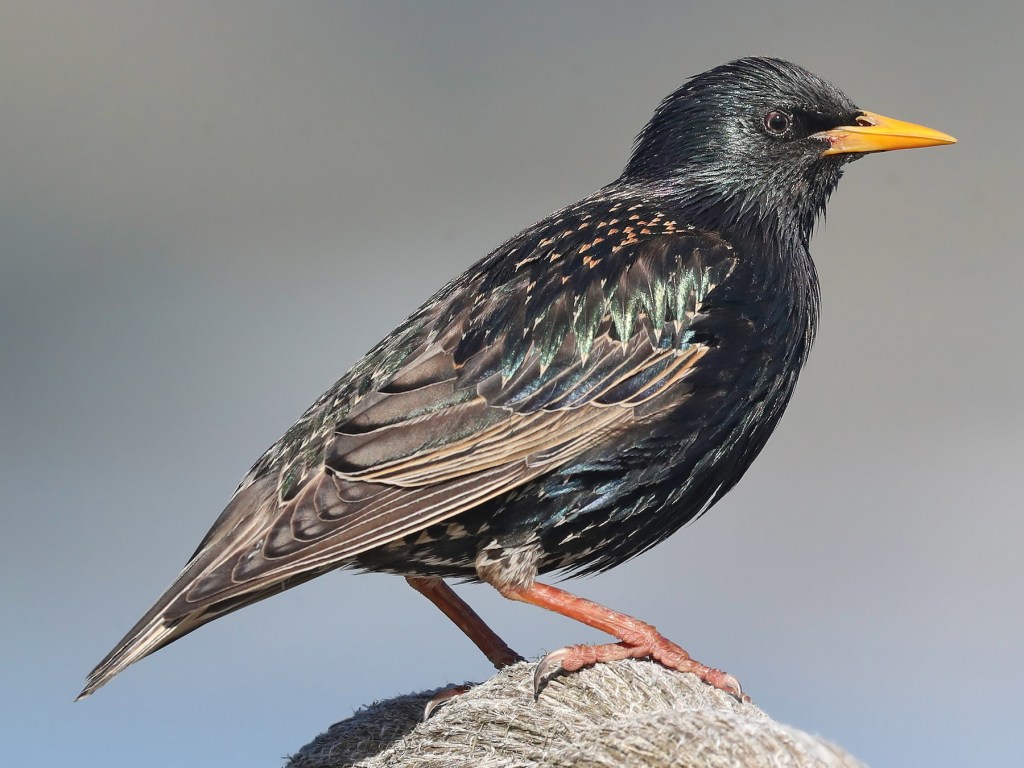
I knew I was witnessing a murmuration of what looked like European starlings, but that is all I knew. I’ve since learned much more.
Merriam-Webster, in fact, gives a spare definition of murmuration: “the act of murmuring,” and “of starlings: flock.” It offers no hint of the incredible phenomenon for which starlings, in particular, are known. The name comes from the sound the birds’ wings make as they fly together in formation.
So why do starlings gather in jaw-dropping numbers to engage in fanciful flight dances? It turns out their motives are not fanciful at all. One, according to treehugger.com, is safety in numbers. While I saw no hawk or other raptor in the area, flocks of starlings, not unlike schools of fish, avoid predation by moving swiftly and unexpectedly together.
In addition, starlings will often form murmurations above a chosen roosting site. This is why they often occur at sundown. Roosting in large numbers allows the birds to share body heat when temperatures dip, and to inform each other about food sources.
Yet, how starlings are able to form murmurations is a mystery. According to the Cornell Lab of Ornithology website, a group of computational physicists who studied starling murmurations found that these flocks model a rare, complex, physical phenomenon known as scale-free correlation. That is, when one starling changes direction or speed, each member of the flock responds almost instantaneously, regardless of the flock size.
Another group of physicists determined that individuals in large flocks consistently coordinate their movements with their seven nearest neighbors. Whenever a single bird moves, its immediate neighbors follow suit, creating a wave-like movement that reverberates throughout the flock.

Still, neither finding explains how starlings are capable of such extraordinary, collective responses. Though European starlings are known best for this behavior, birdful.org notes that in North America, other birds, including American robins, blackbirds, and grackles, may also gather in murmurations before settling into their roosts for the night.
Seeing a murmuration and understanding its purpose has piqued my interest in European starlings, birds I’ve always considered to be homely, pesky bullies. Starlings will descend on feeders in large groups and chase off other birds. They are messy cavity nesters and, after supplanting native birds, including bluebirds, from nesting sites, will render the sites soiled and more difficult to use.
As its name proclaims, the European starling is a nonnative species. Treehugger.com notes that the bird was introduced to the United States by Shakespeare enthusiasts in the 1800s. (A starling is mentioned in Henry IV, Act 1.)
In 1890, Eugene Schieffelin, a New York pharmacist, Shakespeare fanatic, and chairman of the American Acclimatization Society (a group devoted to introducing European plants and animals to North America—yikes!!), released 60 starlings in New York City’s Central Park. No one knew how they would fare. Now, 135 years and some 200 million starlings later, we know.
Back at the Southridge shopping center, I noticed that as the sky grew darker, the starlings began to fly lower and lower. Finally, the entire flock disappeared into a slim line of tall, shrubby trees behind the Panera and beside a Hampton Inn. How they all fit into that cozy grove, I do not know!
European starlings will never be a favorite bird of mine. However, I think we have much to learn from their exquisite sense of community, that is, how attuned they are to one another, how they protect one another from danger, and how they make sure everyone in the flock is warm and well fed.
Find out more about murmurations at these links:
The Incredible Science Behind Starling Murmurations
Why don’t birds collide when they are flying close together in tight flocks? | All About Birds
Are starlings the only birds that murmuration? – Birdful
Ever Wonder How European Starlings Came to the U.S.? Blame Shakespeare


 Sheila McEntee
Leave a reply to Sheila Cancel reply