
Four-minute read
In my last blog post, I described my glee while watching baby birds in my yard, especially a pair of fledgling Northern cardinals. I hoped hard that these babies would live. They were the third brood this season of a cardinal couple that nests annually in my yard. The second brood did not survive.
In mid-May, I watched the female cardinal begin to build a nest in my sprawling oakleaf hydrangea.
“Oh, no, not there,” I cautioned her. “You’ll be too exposed. And those branches aren’t sturdy!”
But she ignored me, and before long, she’d woven a nest of soft, plastic scraps; a few dry leaves; and countless tiny, grasslike twigs. The nest was wide and shallow. Soon after that, she began warming eggs in it.
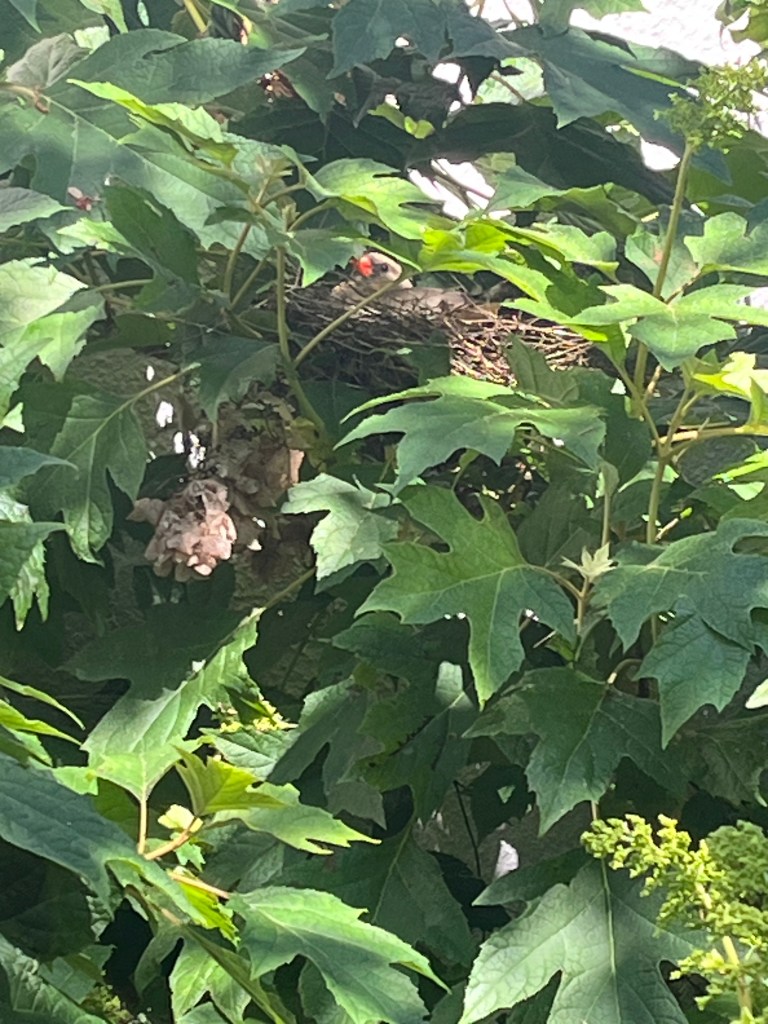
Then, rains came. Day after day it rained hard. Every day I looked out and saw the female on the nest, her back soaked, her head dripping. Yet, she never moved. Like an anxious old auntie, I wrung my hands. I always love a good rain. But now, I begged it to stop.
While the female sat on the nest, day after day, her mate was busy feeding two juvenile birds from their last brood. (I didn’t see where they nested the first time.) I would see the trio in my cherry tree, the father bird handily cracking sunflower seeds and feeding them to the two young birds. What superparents these cardinals were: one babysitting ’round the clock without relief, the other feeding toddlers all day long!
Then, storms came. There was more heavy rain, and strong winds rocked the nest. Though buffeted and soaked, the female hung on. The nest began to tilt slightly in the flimsy branches.
After many days, the female left the nest momentarily and I saw movement in it. She’d successfully birthed two tiny, pink, featherless nestlings.
Yet, not long after that, I came outside one early evening to find the mother bird “chipping” nonstop. She was not at the nest but below it, near the ground, amid the broad leaves of the hydrangea. I ran to my garage to get a ladder. Peering into the nest, I saw no babies. While the mother chipped and chipped, now from the cherry tree, I looked deeper into the shrub. There I found both baby birds on the ground, one opening its oversized bill soundlessly.

With the female watching from the cherry tree and my son-in-law guiding me from the ladder, I scooped up the babies gently and put them back in the nest. They were round, fleshy, and limp, and still featherless.
Back inside, holding a shred of hope, I heard the mother chipping as she returned to the nest. An hour later, as night fell, I peeked outside. I could see the two babies in the nest, motionless. The mother was gone.
It is hard not to anthropomorphize. After days and days of devotion, through terrible wind and rain, the mother cardinal lost her babies. I, on the other hand, was snug inside, chatting with my children, who’d all come to town for the launch of my new book, Soul Friend: And Other Love Notes to the Natural World. In the midst of the celebration, my heart was heavy: one mom had a full nest, the other, an empty one.
Later, I dug a hole in some soft dirt in my garden and placed the lifeless babies in it. I covered them with soil and placed a rock on top to discourage curious predators.
Some weeks later, I noticed the female cardinal building a new nest in the boxwood. This one was deeper, more sheltered, and better secured.
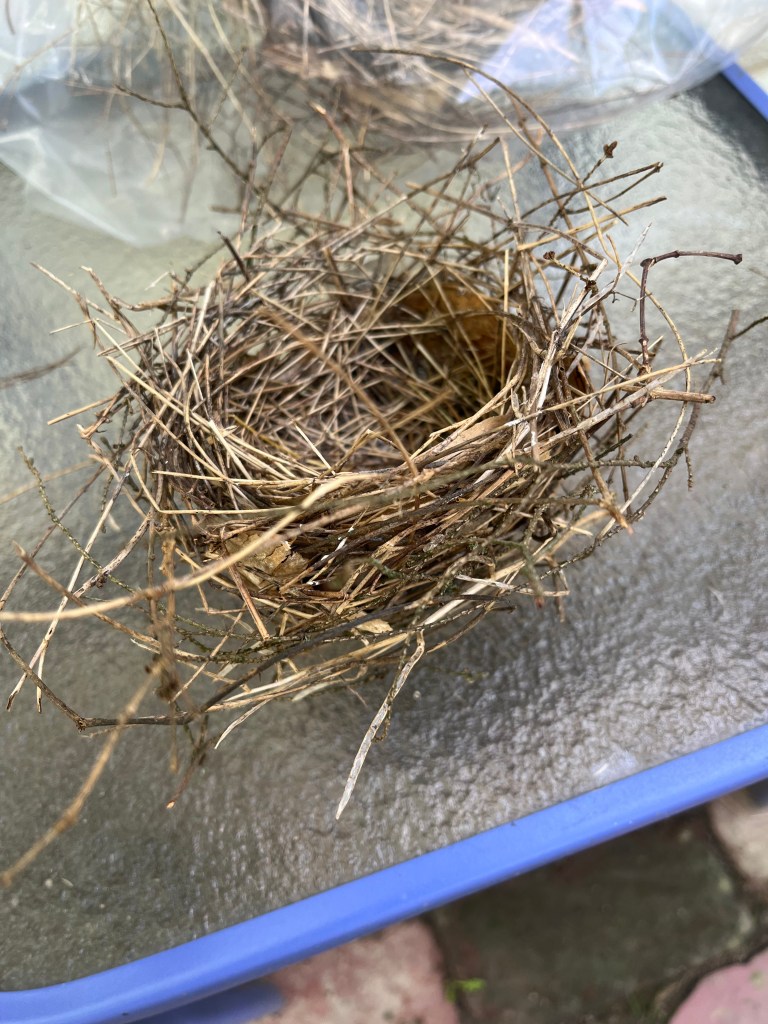
Now that the babies have fledged from that nest, I wonder: Did they survive? I’ve not seen them in many days. Yet, the parent birds come and go from my feeders all day long. Are they bringing food to their young? Will I look out one day and see the male at the feeder with those two youngsters in tow?
I’m not wringing my hands, but I’m keeping a lookout. My fingers are crossed. At least for now, I can enjoy a good rain.

 Sheila McEntee
Leave a reply to Dan Cancel reply