
Three-minute read
Looking out my living room window recently, I was reminded of an old-time hospital maternity ward, where well-wishers gathered behind glass to view sleepy, swaddled newborns. Outside my window there were babies galore, but they weren’t sleepy or swaddled; they were hopping about, shadowing their parents, already learning so much about the world.
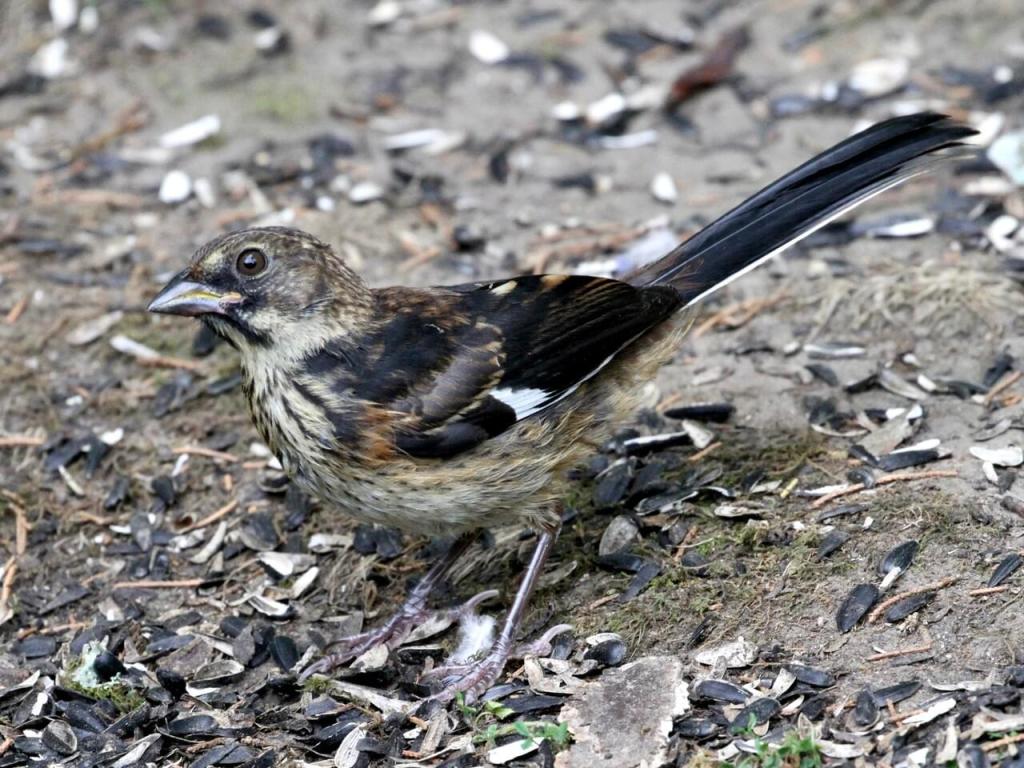
Beneath my birdfeeder I spied a whole family of Eastern towhees: an adult male and female and two juveniles, all probing the ground for fallen seeds. The brownish, streaked juveniles had already learned the “shuffle backwards and scratch” dance towhees do while foraging.
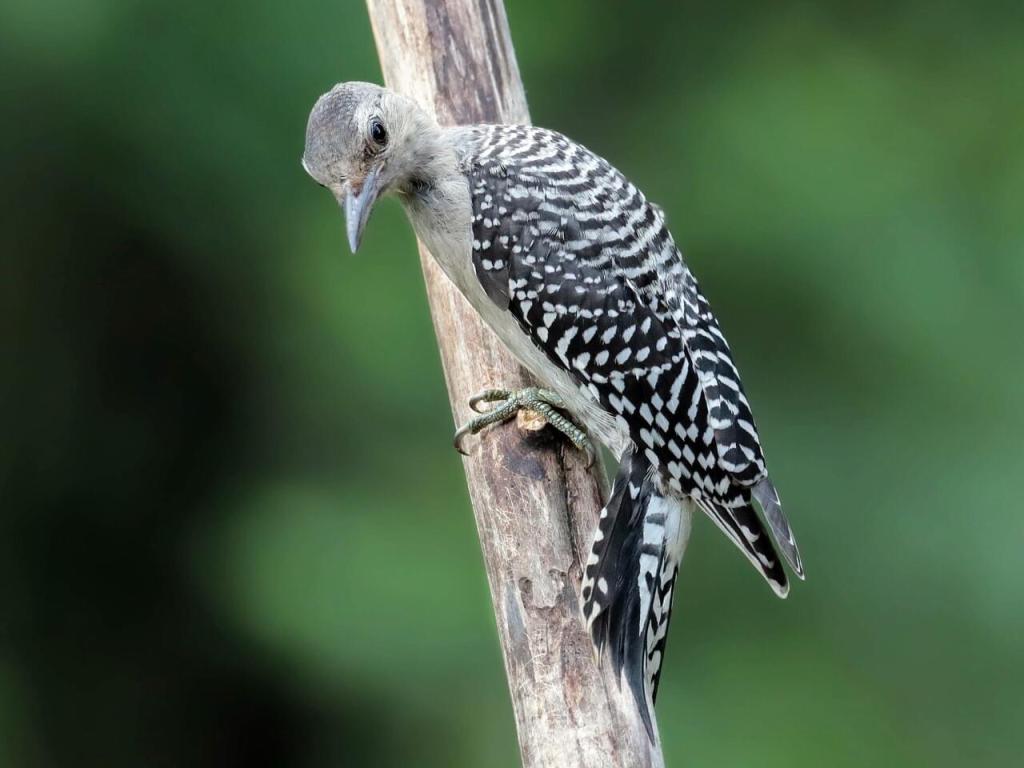
Soon thereafter, a male red-bellied woodpecker arrived with a smaller, lookalike bird that had only the slightest tinge of red on the top of its head. This was surely a recently fledged nestling, learning from its dad how and where to find food. The younger bird proved quite adept at clinging to the feeder and extracting seeds.
Next, a flock of five identical blue jays descended into the branches of my silver maple. Perhaps two adult pairs and a juvenile? All were hopping and squawking, determined to polish off the peanuts I had tossed at the foot of the tree.
Indeed, like clever thieves, they pilfered every last nut, then disappeared. This was good because the Northern cardinal pair that nests in my yard every year had been working hard to run off the jays. Blue jays will rob other birds’ nests, and on that very day, two baby cardinals had fledged from a nest in the boxwood by my front door!
I had been watching the cardinal female for many days. That morning, I expected to step outside and see her perched on the edge of the nest, pressing food down two tiny gullets. But instead, I heard constant peeping, and when I peered out the door, I saw one brown, feathery ball of a bird, with no tail, perched in the branches of my sprawling oakleaf hydrangea, which is next to the boxwood. The other baby was still in the nest, preparing to make the leap.
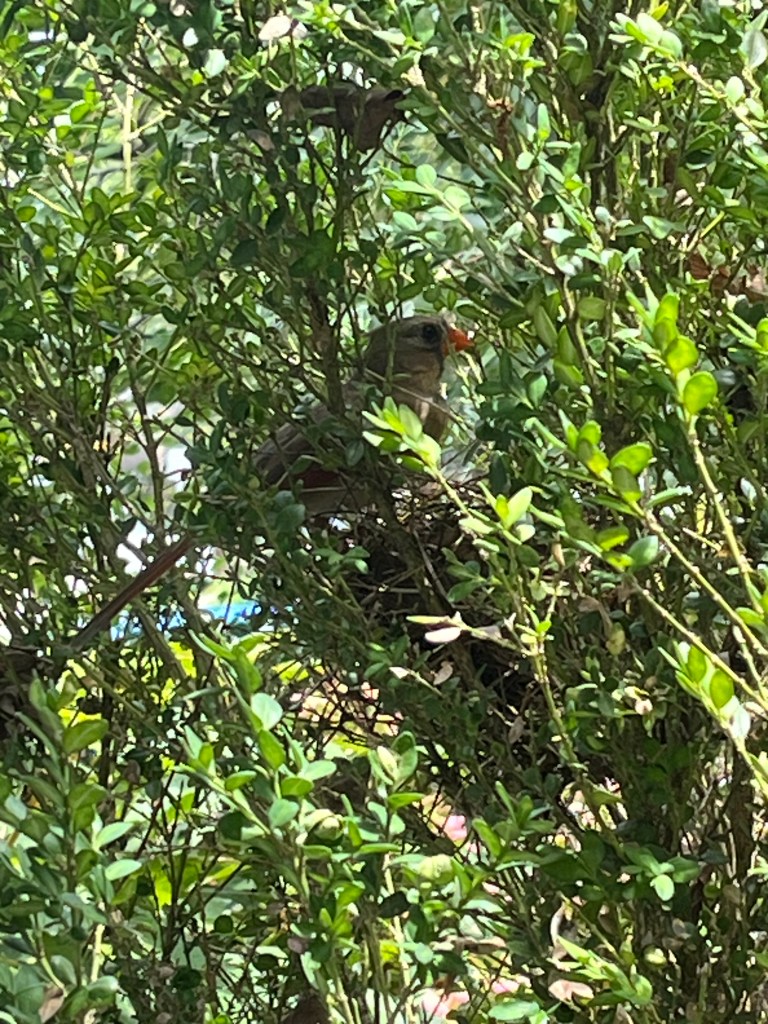
Both parent birds leaped into action. Never but a few feet from the babies, they hovered and hopped, as the tiny birds made their way to the ground, then across the yard and into the hedges that border the street. While shepherding their brood, the parents also defended them mightily. The female extended her wings and flattened her body to intimidate all perceived threats to her young—squirrels, chipmunks, other birds.
The parents tended and defended from morning till dusk. As daylight grew dim, I saw one of the babies, fluttering and peeping, perched 20 feet high in my cherry tree. Both parents, first the male and then the female, flew to the baby, leaned in, and filled its tiny, gaping mouth.
I remember what it’s like to chase a toddler around all day. By nightfall, the cardinal parents must have been utterly exhausted!
Like a gleeful well-wisher, I spent a lot of time by the window that hot July day. My advice is, if you want to get anything done, take down your birdfeeders in summer and don’t go near the windows. But if you want to feel close to nature and share the joys and challenges (more on that next time) of avian family life, ignore my advice and grab your binoculars.

 Sheila McEntee
Leave a reply to Dan Cancel reply